Aspirin and Rosuvastatin Explained: Rosomni-A 75/10
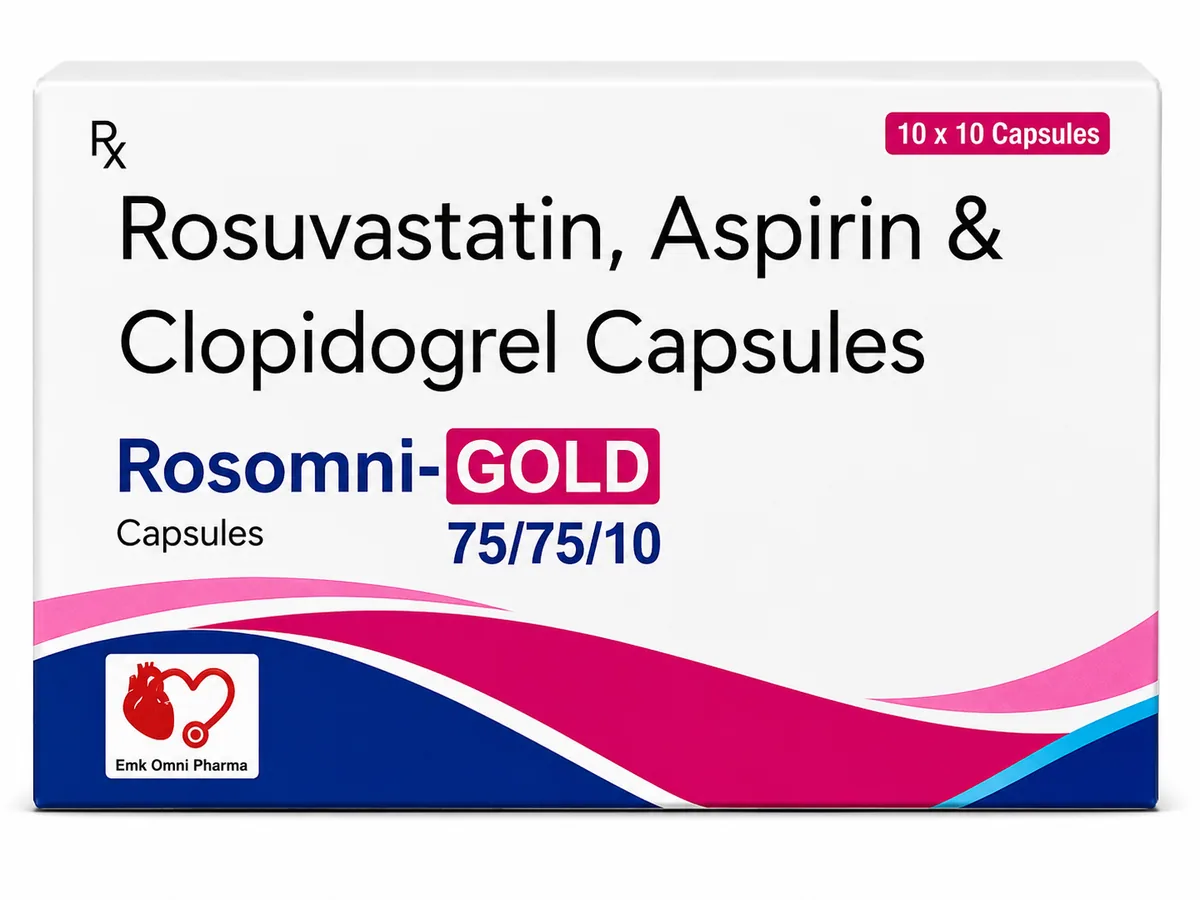
Rosomni-A 75/10: Aspirin Gastro-resistant and Rosuvastatin Capsules IP
A plain explanation of the two molecules inside Rosomni-A 75/10, the drug classes they belong to, how they differ from their cousins, and why they are packed together.
Aspirin: An Old Molecule with a Modern Job
Aspirin, chemically acetylsalicylic acid, grew out of salicylates found in willow bark and has been in medical use for well over a century. For most of that time it was known as a painkiller and fever medicine.
Its cardiac role came later, once researchers understood that aspirin blocks the enzyme cyclo-oxygenase permanently rather than temporarily. Platelets have no nucleus, so they cannot make fresh enzyme. One small daily dose keeps their thromboxane A2 production suppressed for the whole life of that platelet, roughly a week to ten days.
This is why the antiplatelet dose is small. At 75 mg the drug is aiming at platelets, not at inflammation. Higher doses do not add antiplatelet benefit but do add stomach and bleeding risk, which is one reason self-adjusting the dose is a bad idea.
Rosuvastatin: Where It Sits Among the Statins
Rosuvastatin belongs to the statin family, formally the HMG-CoA reductase inhibitors. All statins interrupt the same early step in the liver's cholesterol assembly line, but they differ in potency, in how long they last and in how they are handled by the body.
Rosuvastatin is among the more potent members of the class, so a modest milligram number can achieve a substantial fall in LDL cholesterol. It is hydrophilic, meaning water-loving rather than fat-loving, and it is taken up quite selectively by liver cells. It has a long duration of action, which is why it does not need to be taken at bedtime the way short-acting statins traditionally were. It is also metabolised only to a small extent by the liver's CYP3A4 pathway, so it escapes several interactions that trouble some other statins.
Doctors also know that blood levels of rosuvastatin tend to run higher in people of Asian ancestry, which is one reason prescribers in India are careful about the milligram strength they choose.
Why a Combination Capsule Exists
Atherosclerosis has two faces. There is the slow build-up of cholesterol-rich plaque in the artery wall, and there is the sudden clot that forms when a plaque cracks. A statin addresses the first. An antiplatelet addresses the second. Neither substitutes for the other, which is why cardiologists so often prescribe them together.
A fixed-dose combination brings the two into one capsule for the patient whose doctor wants exactly that pairing. The point is adherence. Cardiac patients frequently take four, five or more medicines, and every extra strip is an extra chance to forget. Combining does not make either ingredient stronger and it does not remove either ingredient's cautions.
The trade-off is flexibility. If a doctor later wants a different statin strength or wants to pause the aspirin, a fixed combination cannot be split. That decision has to be made by the prescriber, who will simply change the prescription.
Pellets, Coatings and the IP Standard
The generic name of the product tells you how it is built: Aspirin Gastro-resistant and Rosuvastatin Capsules IP. Inside the hard gelatin shell are two populations of pellet.
The aspirin pellets carry a gastro-resistant, sometimes called enteric, coating. It is formulated to resist stomach acid and to break down in the less acidic environment further along the gut. The intention is to spare the stomach lining from direct contact. It reduces local irritation, though it cannot remove the bleeding risk that comes from aspirin's effect on platelets throughout the body.
The rosuvastatin pellets release in the usual way, since there is no reason to delay them.
The letters IP stand for Indian Pharmacopoeia, the official standard book of medicine quality in India. When a label says Aspirin IP 75 mg and Rosuvastatin Calcium IP, it is declaring that the ingredients meet those published standards for identity, purity and content.
This article is for general information only and is not a substitute for advice from a registered medical practitioner.
Frequently asked questions
- Is rosuvastatin stronger than other statins?
- It is one of the more potent statins per milligram, so a smaller number on the label can achieve a similar LDL reduction. Potency alone does not decide which statin suits a patient.
- Why is 75 mg of aspirin used and not 325 mg?
- Seventy-five milligrams is enough to keep platelet thromboxane production suppressed. Larger doses add stomach and bleeding risk without adding antiplatelet benefit.
- What does gastro-resistant actually mean?
- The pellet has a coating designed not to dissolve in stomach acid, so the aspirin is released further down the digestive tract. This aims to reduce direct stomach irritation.
- Does rosuvastatin have to be taken at night?
- Not necessarily. It is long-acting, so unlike some older statins it can be taken at a convenient hour, as long as the same hour is kept every day.
- What does IP after the ingredient name mean?
- IP stands for Indian Pharmacopoeia, the official quality standard for medicines in India. It indicates that the ingredient conforms to that published monograph.
- Why does the doctor ask about my ancestry or origin for a statin?
- Rosuvastatin blood levels tend to be higher in people of Asian ancestry, so prescribers often take that into account when selecting the strength.
Need Rosomni-A 75/10 for your pharmacy, hospital or clinic?
EMK Omni Pharma supplies through authorised channels across Karnataka. Send an enquiry and our team will respond during business hours.
Related guides
Medical Disclaimer
This product information is intended for general awareness only and should not be considered medical advice. Please consult a registered medical practitioner before using any prescription medicine.