Cilnidipine Explained: How Cilomni-10 Works
Cilomni-10: Cilnidipine Tablets IP 10 mg
Cilnidipine is the molecule inside Cilomni-10. This article explains its drug class, its unusual dual action on two types of calcium channel, and how combinations are built around it.
What Is Cilnidipine, the Molecule in Cilomni-10?
Cilnidipine is the active pharmaceutical ingredient in Cilomni-10, present as Cilnidipine IP 10 mg in each film-coated tablet. The letters IP mean the material meets the standards of the Indian Pharmacopoeia.
It is a small molecule taken by mouth, absorbed from the gut, processed largely by the liver and given once daily in most prescriptions. Its job is to lower the pressure inside arteries by relaxing the muscle in their walls.
Cilnidipine was developed in Japan and has been used in Asia for many years in the management of high blood pressure. It is now widely prescribed in India, both alone and as part of fixed-dose combinations.
The Drug Class: Dihydropyridine Calcium Channel Blockers
Calcium channel blockers fall into two broad camps. The non-dihydropyridines act strongly on the heart itself, slowing conduction and rate. The dihydropyridines, whose names end in -dipine, act mainly on the arteries and are the group used most for blood pressure.
Cilnidipine belongs to the dihydropyridine camp. Members of this group are valued because they lower pressure reliably, work well in older patients, combine easily with other medicines, and do not interfere with blood sugar or with cholesterol.
The common class trade-off is vasodilatory effects: flushing, headache and, in some people, fluid collecting around the ankles. Much of the development within this class over the years has been about keeping the pressure-lowering while reducing those effects.
L-Type and N-Type: Cilnidipine's Dual Action
Blood vessels have L-type calcium channels in their smooth muscle. Blocking these is how every dihydropyridine lowers blood pressure, and cilnidipine does this too.
What distinguishes cilnidipine is that it also blocks N-type calcium channels. These sit on the endings of sympathetic nerves, the nerves of the fight-or-flight system. When they are blocked, less noradrenaline is released.
That second action matters for two reasons. First, when arteries widen, the body often responds by speeding the heart. Damping sympathetic output makes that reflex less pronounced. Second, sympathetic activity contributes to the pattern of pressure inside small vessels that pushes fluid into the tissues, which is one explanation offered for why ankle swelling is reported less often with cilnidipine. Cilnidipine also relaxes both the incoming and the outgoing arterioles of the kidney's filtering units, which is why it interests doctors treating patients with protein in the urine.
How Cilnidipine Compares Within Its Class
Comparisons between medicines in the same class are best made conceptually rather than as a ranking, because the right choice depends on the patient in front of the doctor.
Older dihydropyridines act on L-type channels alone. Later molecules were designed for longer, smoother action so that pressure does not swing between doses. Cilnidipine is often described as a later-generation agent because of the added N-type activity.
What this means in the clinic is that a doctor may choose cilnidipine for someone who found a previous medicine in the class caused troublesome ankle swelling or palpitations, or for someone in whom reducing sympathetic drive seems useful. It does not make cilnidipine automatically the right answer for everyone, and switching between molecules is never a decision for the patient to make alone.
Why Combination Tablets Are Built Around Cilnidipine
Most people with hypertension need more than one mechanism to reach the target their doctor has set. Rather than two separate strips, manufacturers place two molecules into one tablet.
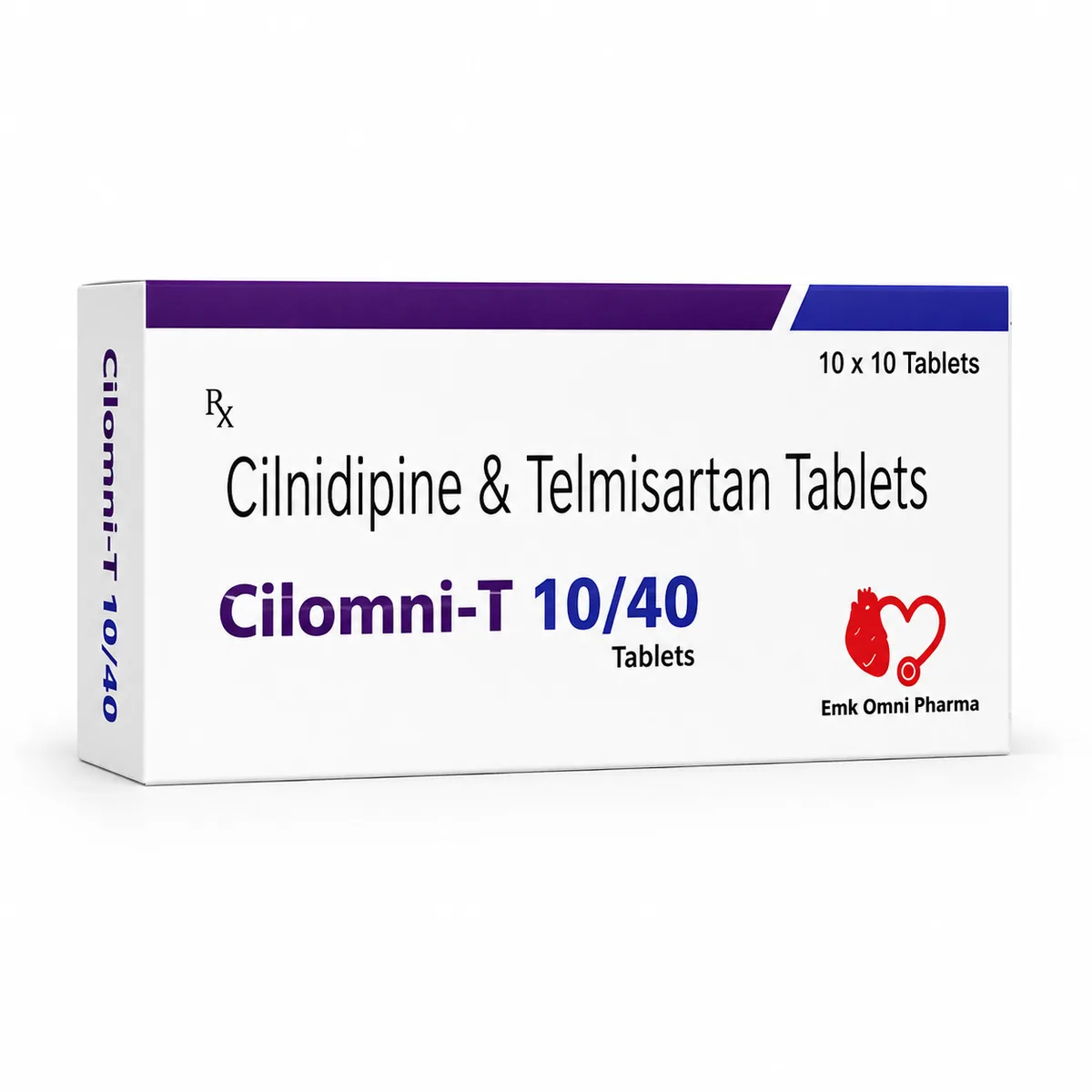
This is why EMK Omni Pharma markets Cilomni-T 10/40 alongside Cilomni-10. It brings together cilnidipine 10 mg, which relaxes arteries directly, and telmisartan 40 mg, an angiotensin receptor blocker that works through a different hormonal pathway. The two act at different points, and ARBs are also known to reduce the ankle swelling that calcium channel blockers can cause.
Fewer tablets usually means better adherence, which is one of the strongest predictors of good long-term control. The trade-off is less flexibility: a fixed-dose combination cannot be adjusted one molecule at a time. That is exactly the sort of judgement a doctor makes, and it is covered further in the comparison article.
This article is for general information only and is not a substitute for advice from a registered medical practitioner.
Frequently asked questions
- What does IP mean in Cilnidipine Tablets IP?
- IP stands for Indian Pharmacopoeia. It indicates the ingredient and the finished tablet meet the standards laid down in that official compendium.
- Is cilnidipine the same as other -dipine medicines?
- They share the dihydropyridine class and the same core action on artery walls, but cilnidipine adds N-type channel blockade, which the others do not have.
- Does cilnidipine slow the heart rate?
- It is not a rate-lowering medicine, but by reducing sympathetic nerve output it makes a reflex rise in pulse less likely than with some relatives.
- Why do doctors talk about cilnidipine and the kidneys?
- It relaxes both the afferent and efferent arterioles in the kidney, which has drawn interest in patients with protein in the urine. Your doctor decides its relevance for you.
- Is a combination tablet stronger than Cilomni-10?
- It is not stronger, it is different. A combination adds a second mechanism rather than more of the same molecule.
- Can I ask my doctor to switch me to cilnidipine?
- You can certainly raise it, especially if a previous medicine caused swelling or palpitations. The final choice is a clinical one.
Need Cilomni-10 for your pharmacy, hospital or clinic?
EMK Omni Pharma supplies through authorised channels across Karnataka. Send an enquiry and our team will respond during business hours.
Related guides
Medical Disclaimer
This product information is intended for general awareness only and should not be considered medical advice. Please consult a registered medical practitioner before using any prescription medicine.