Nicomni-5 vs Angi-NTG 2.6: How Doctors Choose
Nicomni-5: Nicorandil Tablets IP 5 mg
Nicomni-5 and Angi-NTG 2.6 are both prescribed in angina but contain different molecules with different behaviour. Here is how a doctor thinks about the choice and why self switching is unsafe.
Two anti anginal medicines, two different molecules
Both products in this comparison come from the EMK Omni Pharma cardiac range, and both are prescribed in angina, but they are not versions of the same thing.
- Nicomni-5 is Nicorandil Tablets IP 5 mg, an uncoated tablet in a bottle of 20, stored in a dry place at 2 degrees C to 8 degrees C
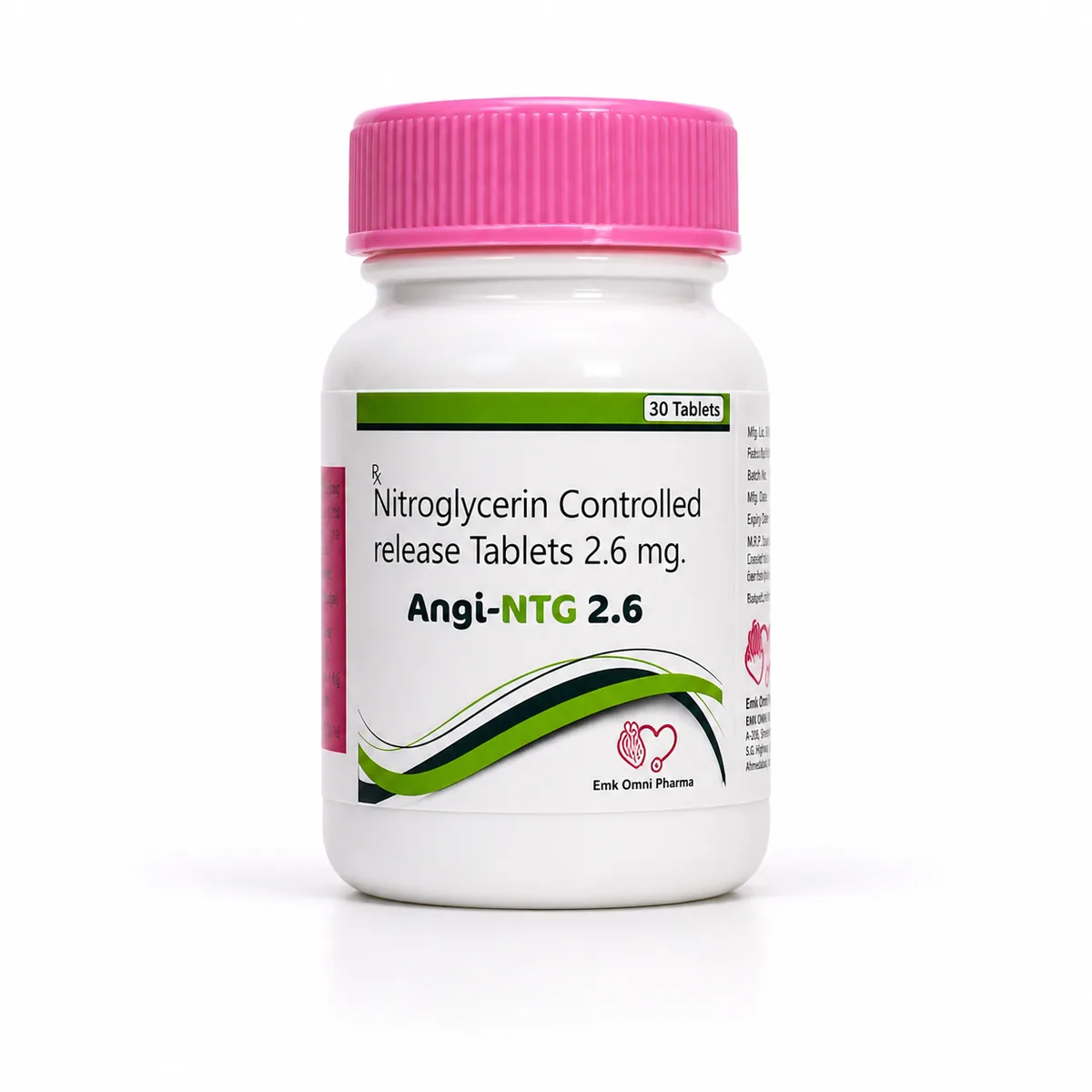
- Angi-NTG 2.6 is Nitroglycerin Controlled Release Tablets 2.6 mg, a controlled release format of a classic nitrate
The first thing to clear up is the numbers. 5 mg of nicorandil and 2.6 mg of nitroglycerin describe entirely different molecules. One is not stronger than the other because the number is larger. Comparing milligrams across molecules is like comparing kilometres with kilograms.
Both are Schedule H medicines. Neither can be bought over the counter, and neither should be started, stopped or exchanged without a prescription.
How each medicine works
Nitroglycerin, the molecule in Angi-NTG 2.6, is the classic nitrate. It releases nitric oxide, which relaxes smooth muscle, mainly in the veins. Less blood returns to the heart, the chamber is less stretched and oxygen demand falls. Coronary vessels also widen. The controlled release format is designed to spread that effect out over time rather than acting in a short burst.
Nicorandil, the molecule in Nicomni-5, does the same nitrate style job with one half of its structure and adds a second action. It opens ATP sensitive potassium channels in artery walls, relaxing the resistance arteries and reducing the pressure the heart pumps against.
One practical difference doctors think about is that continuous exposure to a nitrate is known to reduce its effect over time unless a nitrate free interval is built into the daily schedule. The second mechanism in nicorandil is one reason its behaviour differs on that point. This is a general pharmacology observation rather than a claim about how any individual will respond.
What a doctor weighs when choosing
The choice is rarely about one medicine being better in general. It is about the fit for one person.
- Current blood pressure and pulse. Both medicines relax vessels, so a person who already runs low may need a careful start
- What is already prescribed. If a patient is on a beta blocker and a calcium channel blocker and still has symptoms, the doctor picks the medicine that adds a different mechanism
- How the angina behaves. Predictable exertional symptoms, night time symptoms and symptoms in the early morning may all point in different directions
- Tolerance. If a person has had troublesome headache on a nitrate, that history matters
- Other conditions. Heart failure, kidney or liver disease, a history of gut ulcers and glaucoma all influence the decision
- Dosing schedule. A controlled release format may suit one routine, while a different pattern suits another
- Practical storage. Nicomni-5 asks for cold storage and has an 8 week limit after opening, which is worth discussing with a patient who travels often
Some patients are prescribed a nitrate and nicorandil together in a planned way. That combination is a medical decision, since both lower blood pressure.
Why patients must not switch or change strength on their own
It is tempting to think that if one anti anginal tablet is not available at the chemist, another from the same shelf will do. It will not.
- Different molecules behave differently. Duration of action, the way the dose is spread through the day and side effect patterns are not interchangeable
- Doses are not equivalent. There is no simple conversion between nicorandil and nitroglycerin
- Combining doubles the vessel relaxing effect. Taking a replacement while still taking the original can drop blood pressure sharply
- Interactions differ in the details even though both carry the strict rule against medicines for erectile dysfunction
- Stopping an anti anginal medicine abruptly can allow symptoms to return
If your usual brand is not in stock, ask the chemist to source it, or call your doctor. Do not accept a substitute from a different molecule without a fresh prescription, and never adjust the number of tablets to compensate.
This article is for general information only and is not a substitute for advice from a registered medical practitioner.
Frequently asked questions
- Is Nicomni-5 stronger than Angi-NTG 2.6?
- The question does not apply. They contain different molecules, so 5 mg of nicorandil cannot be compared with 2.6 mg of nitroglycerin by number alone.
- Can I switch from one to the other if my chemist is out of stock?
- No. That requires a fresh prescription from your doctor. Ask the chemist to source your prescribed brand or call your doctor for advice.
- Can both be taken together?
- Only if a doctor prescribes the combination deliberately, because both lower blood pressure. Never add one to the other on your own.
- Why did my doctor choose nicorandil over a nitrate?
- Reasons vary and may include your other medicines, blood pressure, tolerance and how your angina behaves. Ask your doctor about the reasoning in your case.
- Does either medicine relieve a sudden attack?
- Both are used as regular preventive treatment in this comparison. Ask your doctor separately what to use during an attack and when to reach hospital.
- Are both Schedule H medicines?
- Yes. Both require the prescription of a registered medical practitioner and cannot be sold by retail without one.
Need Nicomni-5 for your pharmacy, hospital or clinic?
EMK Omni Pharma supplies through authorised channels across Karnataka. Send an enquiry and our team will respond during business hours.
Related guides
Medical Disclaimer
This product information is intended for general awareness only and should not be considered medical advice. Please consult a registered medical practitioner before using any prescription medicine.