Metformin and Glimepiride Explained: How Gluomni M1 Works
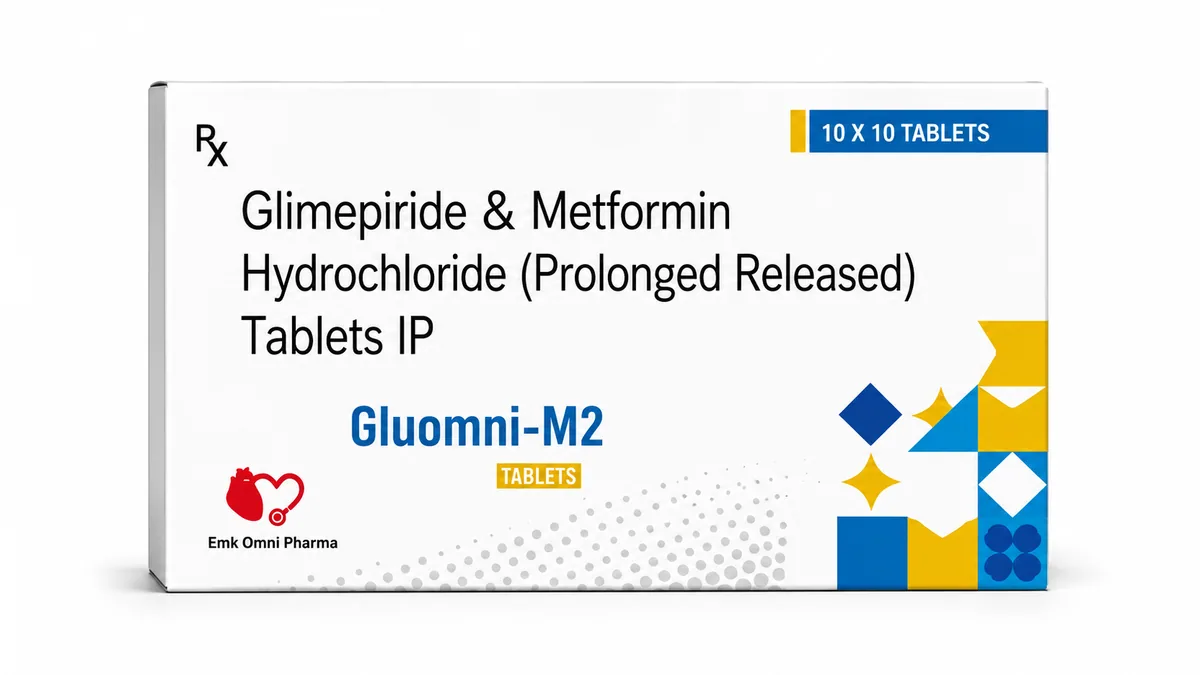
Gluomni M1: Metformin Hydrochloride (SR) & Glimepiride Tablets IP
Gluomni M1 pairs a biguanide with a sulfonylurea. This guide explains both drug classes in plain English and why they are often combined in one bilayer tablet.
What a Biguanide Is: Understanding Metformin
Metformin belongs to a small drug family called the biguanides, whose origins trace back to a plant traditionally used for high blood sugar, the French lilac or goat's rue. Metformin has since become the medicine doctors most often reach for first in type 2 diabetes worldwide.
Its main action is on the liver. In type 2 diabetes the liver keeps releasing glucose even when blood levels are already high, and Metformin dampens that release. It also improves the way muscle and fat tissue respond to insulin, so glucose moves out of the blood more readily, and it slows glucose absorption from the intestine a little.
Because Metformin does not force the pancreas to release insulin, it is unlikely to cause low blood sugar when used on its own. That property changes once a sulfonylurea is added to the same tablet.
What a Sulfonylurea Is: Understanding Glimepiride
Sulfonylureas are among the older families of oral diabetes medicines and remain widely used in India because they work quickly and are affordable. Glimepiride is one of the later members of the family.
It attaches to a receptor on the beta cells in the pancreas, closing a potassium channel and prompting the cell to release the insulin it has stored. Because the effect depends on the pancreas still producing insulin, sulfonylureas are used in type 2 diabetes rather than type 1.
The strength matters. Glimepiride is available in more than one strength, and Gluomni M1 uses 1 mg, the lower of the commonly prescribed options. A lower sulfonylurea content is often preferred when a doctor is starting cautiously or when the person is older.
How Glimepiride Compares Within the Sulfonylurea Class
Conceptually, sulfonylureas differ in how long they act, how strongly they bind, and how they are cleared from the body. Older members of the class tend to act for longer and to carry a greater tendency toward prolonged low blood sugar, particularly in older adults.
Glimepiride is generally described as a once daily sulfonylurea with a relatively selective action on the beta cell receptor. Doctors often choose it when they want a sulfonylurea effect with a simpler daily schedule.
None of this makes any one molecule right for everyone. Choice depends on kidney and liver function, age, meal habits, the risk of low sugar, other medicines and cost. That is a clinical judgement for your doctor, not a comparison a patient should act on alone.
Why the Metformin in Gluomni M1 Is Sustained Release
Plain Metformin releases its full dose soon after swallowing. A high concentration reaching the gut wall at one time is a major reason for the nausea, fullness and loose motions people associate with the drug, and those effects are the commonest reason patients stop taking it.
A sustained release formulation uses a matrix that lets the drug diffuse out slowly over several hours. Many patients find this gentler on the stomach and simpler to fit into the day.
The trade off is that the release system must stay intact. That is why the caution on the Gluomni M1 pack says not to chew or crush the tablet. Breaking it defeats the design and can deliver the Metformin all at once.
Why Fixed Dose Combination Tablets Exist
Type 2 diabetes tends to need more than one medicine over time, because the underlying problem has two parts: the body resists insulin, and the pancreas gradually releases less of it. Metformin addresses the first, a sulfonylurea the second.
Instead of asking a patient to take two separate tablets, manufacturers formulate them together. Gluomni M1 does this as a bilayer tablet, keeping the sustained release Metformin layer physically separate from the Glimepiride layer within one tablet, so each ingredient behaves as intended.
The benefits are practical: fewer tablets, fewer chances of forgetting one of them, and a simpler routine. The limitation is flexibility. A combination fixes the ratio, so if your doctor wants to change only one of the two strengths, a different product or separate tablets may be needed.
What IP on the Gluomni M1 Label Means
The letters IP after an ingredient name stand for Indian Pharmacopoeia. They indicate that the ingredient conforms to the standards of identity, purity and strength laid down in that official compendium.
On the Gluomni M1 pack you will see Metformin Hydrochloride IP 500 mg in sustained release form and Glimepiride IP 1 mg, along with approved excipients. Excipients are the inactive materials that hold the tablet together, control the release rate and keep it stable through storage.
Understanding the label helps you read any prescription with confidence, and it helps you check that a refill matches what your doctor intended. If the composition on a new pack does not match your prescription, ask the chemist before taking it.
This article is for general information only and is not a substitute for advice from a registered medical practitioner.
Frequently asked questions
- What drug class does Metformin belong to?
- Metformin is a biguanide. It mainly reduces glucose released by the liver and improves the body's response to its own insulin.
- What drug class does Glimepiride belong to?
- Glimepiride is a sulfonylurea. It stimulates the beta cells of the pancreas to release more insulin, so it needs a pancreas that still produces some.
- Why does Gluomni M1 use a bilayer tablet?
- The bilayer keeps the sustained release Metformin layer separate from the Glimepiride layer inside one tablet, so each ingredient is released as designed.
- Is sustained release Metformin stronger than plain Metformin?
- It is not stronger. It releases the same drug more gradually, which many people tolerate better in the stomach. Your doctor chooses the form and strength.
- What does IP mean on the pack?
- IP stands for Indian Pharmacopoeia and shows that the ingredient meets that official standard for identity, purity and strength.
- Are excipients important?
- Yes. These approved inactive ingredients bind the tablet, control how the Metformin is released and help keep the product stable during storage.
Need Gluomni M1 for your pharmacy, hospital or clinic?
EMK Omni Pharma supplies through authorised channels across Karnataka. Send an enquiry and our team will respond during business hours.
Related guides
Medical Disclaimer
This product information is intended for general awareness only and should not be considered medical advice. Please consult a registered medical practitioner before using any prescription medicine.